
Good technology makes the complex simple, and bad technology does the opposite. At my first LightSight AI client, the sales order process was clearly in the second camp: a broken workflow that forced customer service reps to spend 20 minutes reading, searching, and manually entering data for every order.
That’s the challenge I’ve been working on at LightSight over the past few weeks: building an AI-powered customer service agent for a team that receives purchase orders by email.
These purchase orders don’t follow one standard format. They can arrive as PDFs, spreadsheets, or scanned documents. Product descriptions may not match the company’s system exactly, and important information may be missing. Before an order can be created, someone has to interpret the document, look up the customer and products, resolve inconsistencies, and enter everything manually.
Generative AI makes it possible to understand these different document formats, but reading the document is only part of the solution.
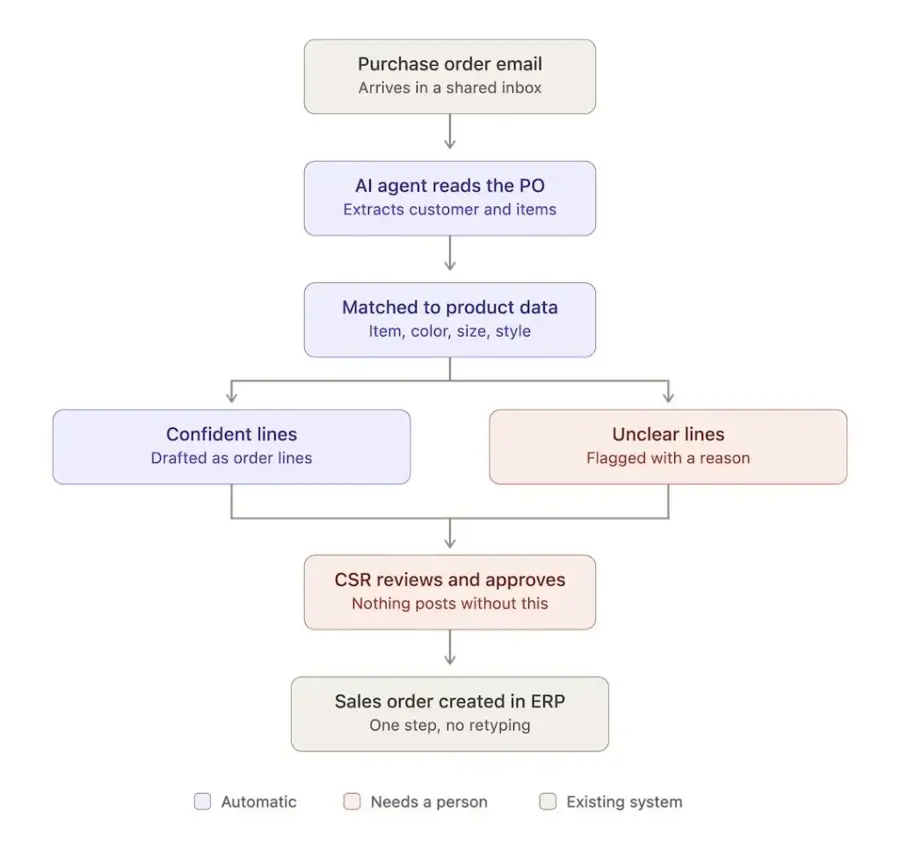
I designed the workflow to normalize inconsistent product information, match each item against the company’s actual product data, identify the correct customer account, and prepare a complete sales order for review.
One of my most important design decisions was making sure the agent never guesses. If a product style is missing or multiple products could be a match, it flags the line for human review instead of quietly choosing one. A person always remains in control of the final decision.
One of my favorite moments was watching the agent automatically process a complex purchase order, matching the product SKUs and customer account while correctly flagging the few items it couldn’t confidently identify. Those flags were just as valuable as the matches because they also revealed gaps in the existing product data.
Customer service should be about managing the human connection with customers. Instead, teams often spend large amounts of time on data lookup and repetitive entry. Generative AI has helped us automate the mundane parts of the job while preserving the human judgment that matters.
What I like most about this project is that it reminds me how ordinary many business problems are. This isn’t a problem that requires years of specialized study to understand, but solving it thoughtfully can still make a meaningful difference for both the company and its employees.
This is the kind of AI work I love: practical, thoughtful, and built around the people who will actually use it.